Avatar

About Me

A researcher aspiring to leverage AI for advancing natural and fundamental sciences.

Self Introduction

Autonym: YuXuan Wu; Pseudonym: Horikita Saku

Majored in artificial intelligence as an undergraduate.

Interested in the intersection of data science and natural sciences, particularly in the realms of biological information and astrophysical.

Currently conducting research on discrete representation and AI applications in bioinformatics and medicine, including GWAS and single-cell analysis.

Kaggle Master.

My personality

I appreciate quiet spaces, reading, listening to the rain and relishing a good cup of coffee.

My favorite book is If On a Winter’s Night a Traveler.

Probably a bit workaholic.

Publications

Resolving the bias-precision paradox with stochastic causal representation learning for personalized medicine

Peisong Zhang, Manqiang Peng, YuXuan Wu, et al.
Nature Biomedical Engineering (Under Review) · 2026

CodeUnlearn: Amortized Zero-Shot Machine Unlearning in Language Models Using Discrete Concept

YuXuan Wu, Bonaventure F. P. Dossou, Dianbo Liu
Neurips 2024 Workshop · 2024

Pages

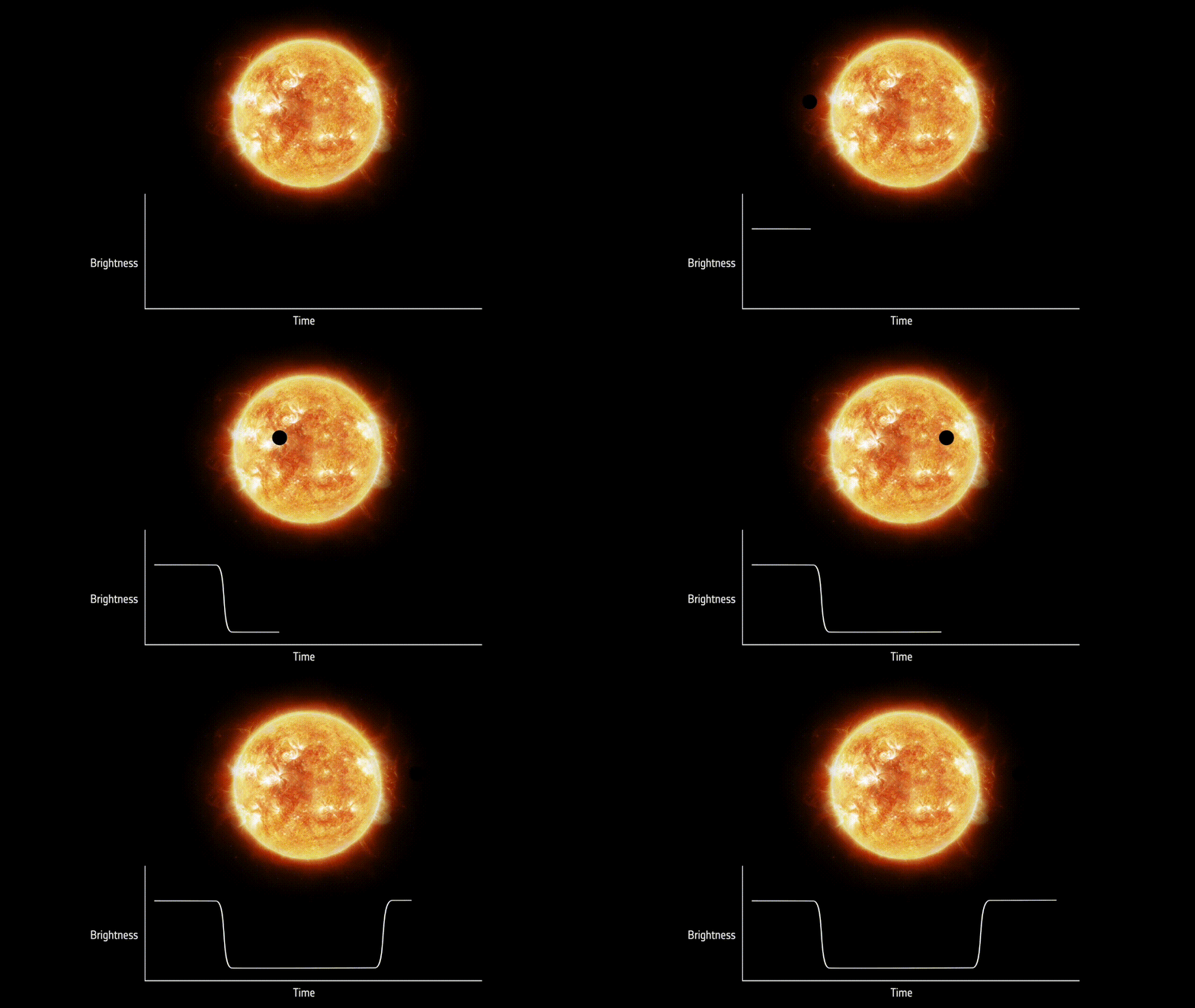
NeurIPS - Ariel Data Challenge 2025 Review

7th place. First gold medal.
2025-09-27
7 min read
Featured Image

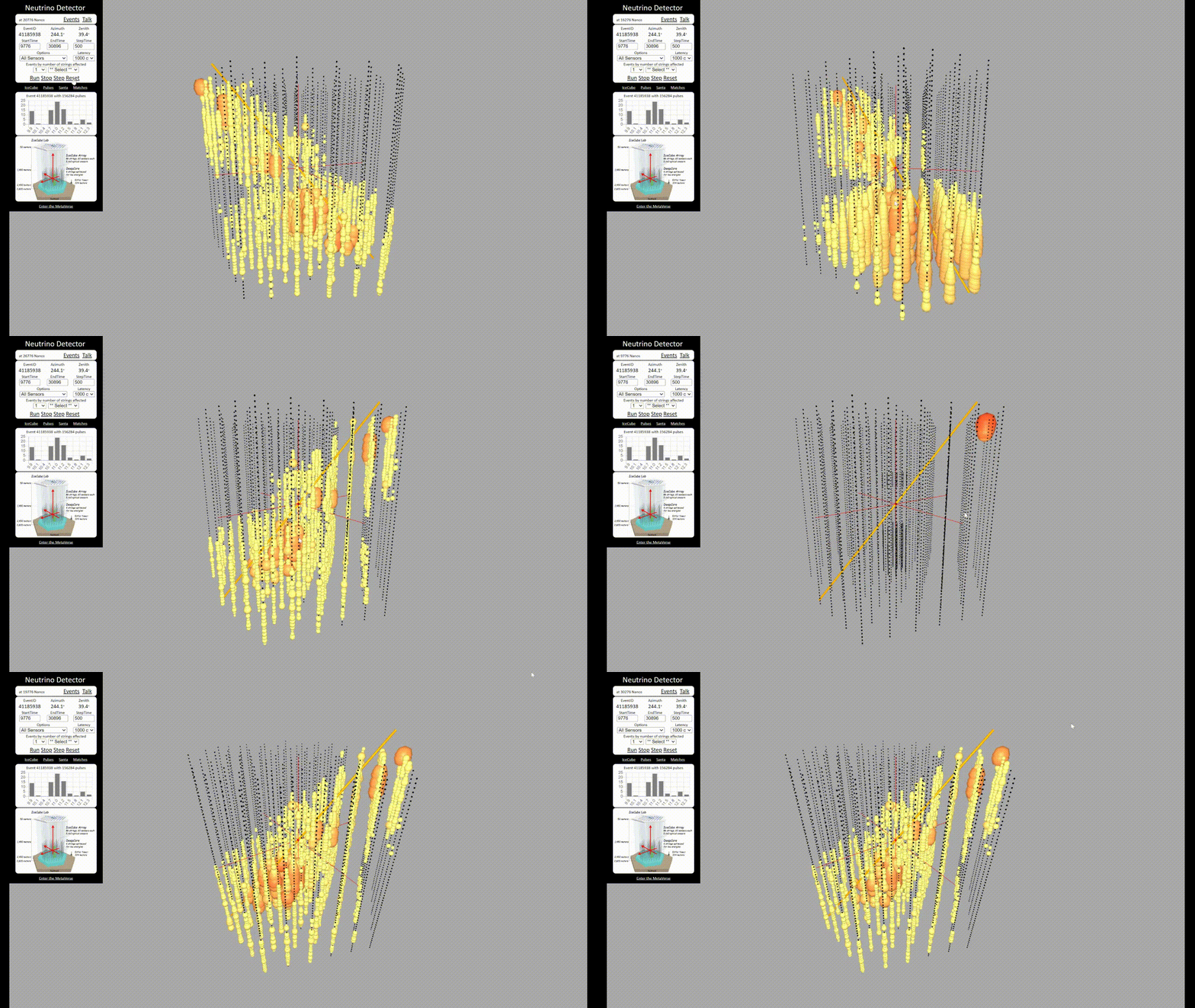
IceCube - Neutrinos in Deep Ice

The top 3% of all participating teams globally. First Silver Medal. My story in the competition.
2023-10-26
10 min read
Featured Image

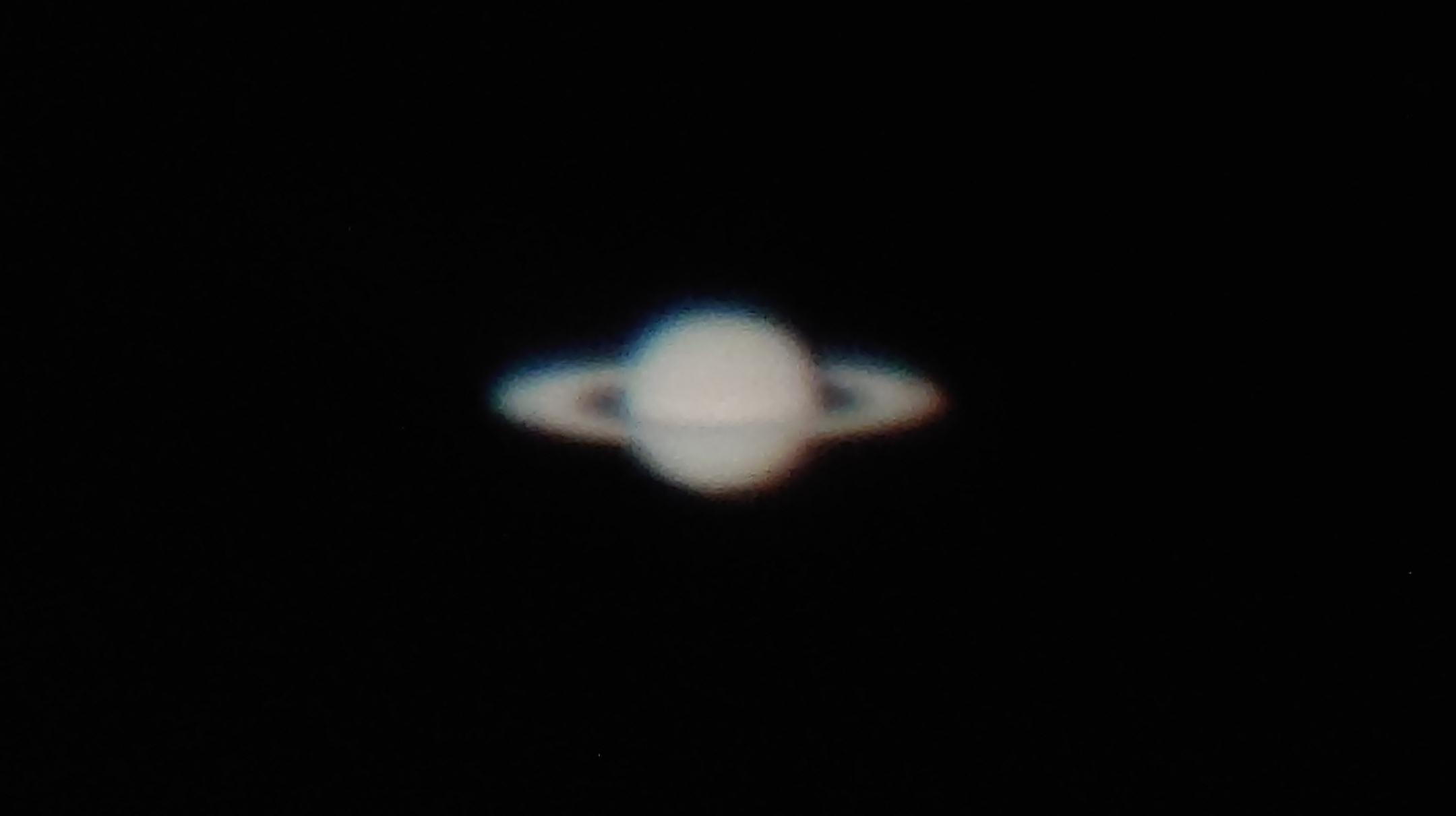
First time with the astronomical telescope.

Try to calibrate astronomical telescopes and make observations of Jupiter and Saturn.
2023-10-11
1 min read
Featured Image

Experience

Kaggle Master

2023 - Present

AI Researcher

2026.2 - Present
  • Developing multilingual medical benchmark datasets to evaluate large language models across linguistic and cultural gaps in clinical contexts.
  • Contributed to evaluation methodology for medical AI systems, focusing on cross-lingual performance and clinical applicability.

Research Assistant

CNCB Jiang Lab · China National Center for Bioinformation
2025.11.15-Present
  • Conducted computational analysis on single-cell and stem cell datasets, focusing on cell state transitions and perturbation responses.
  • Developed models for Virtual Cell Construction, integrating multi-omic data to simulate cellular behavior under various perturbations.
  • Contributed to individual-level virtual modeling, aiming to capture inter-donor variability and predict donor-specific cellular responses.
  • Performed quality control and computational data processing for mesenchymal stem cell (MSC) datasets, supporting stem cell product characterization.

Visiting Scholarship

Cognitve AI for Science Team · National University of Singapore
2024.1-Present
  • Single cell omics analysis
  • VQ-VAE / Discrete Representation / Machine unlearning

NeurIPS - Ariel Data Challenge 2025 - Gold Medal 7th

Predict the area ratio of planets and stars and the confidence level (uncertainty) sigma.

  • Achieved the 7th(1%) in the NeurIPS Competition. Achieve my first gold medal.
  • We have developed a method that spans from heuristic forward modeling to Gaussian processes, to deep learning, and to gradient boosting trees.
  • Become Kaggle Competition Masters.

IceCube - Neutrinos in Deep Ice - Silver Medal(top3%)

Reconstruct the direction of neutrinos from the Universe to the South Pole

  • Achieved the 21th in the Neutrinos and Astrophysics competition, ranking in the top 3% globally among all participating teams.
  • Utilized a 3D point cloud convolution model based on the EdgeConv operator, developed various RNN models, and employed a multi-stage training method grounded in IceCube’s physical principles.
  • This achievement also marks my first medal in Kaggle competitions.

HMS - Harmful Brain Activity Classification - Silver Medal(top2%)

Developed a model trained on Electroencephalography (EEG) signals and Spectrogram recorded from critically ill hospital patients to classify a variety of harmful brain activities.

  • Achieved 38th place in the Neuroscience and Physiology competition, ranking in the top 2% globally among all participating teams.
  • Developed a 1D model based on EEG signals and employed innovative training methods to create an effective 1D+2D multi-modal model.